AI automation for property management companies is mostly a story about volume. One manager may look after a few hundred doors. Each door has a tenant who texts at odd hours, a lease with its own end date and an owner who wants to know what happened this month. Nothing is hard. There’s just a lot of it, and it comes in the wrong order.
We build small AI tools and internal tools around that volume. Your staff approve anything that goes to a tenant, owner or prospect.
The text that says “it’s leaking”
Maintenance requests rarely arrive complete. “Kitchen sink” could be a drip or a flood. A tool can read each request and any photo, ask the tenant two follow-up questions and file a clean ticket that your coordinator can act on.
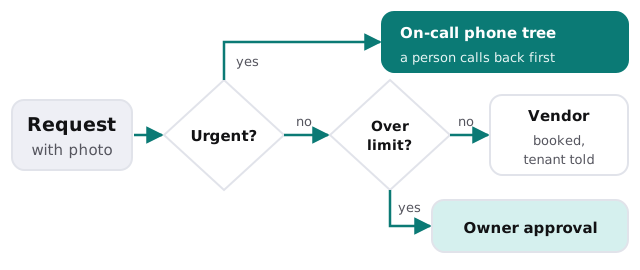
What the coordinator gets
- A one-line summary, the unit, the photo and the tenant’s own words.
- A suggested category and a list of vendors you already use for it.
- The owner’s approval threshold beside the estimate.
- A drafted update for the tenant once the vendor is booked.
Leasing, including the 9pm inquiry
A prospect who writes at night often books the first place that answers. A tool can reply with the facts you’ve approved: rent, availability, pet policy, how to tour. It never says who would be a good fit, and it never answers a question about the neighborhood by describing the people who live there.
That matters because the Fair Housing Act’s advertising provision, 42 U.S.C. 3604(c), makes it unlawful to publish a notice, statement or advertisement about renting a dwelling that expresses a preference, limitation or discrimination based on protected characteristics. A tool drafting at volume is a reason to keep a reviewer and a written set of approved answers. It isn’t a substitute for your own legal advice.
Renewals: start earlier than you think
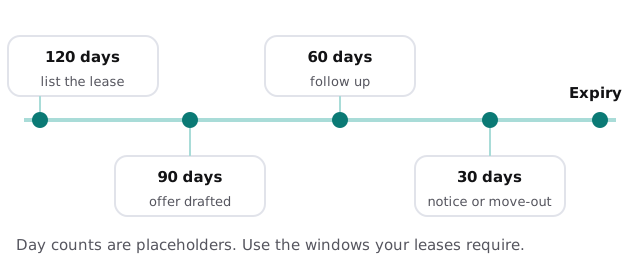
Leases tend to cluster, because many start in the same busy season, so renewals, move-outs and turns can all collide. A tool lists every lease by days left, drafts a renewal offer from the rent your manager sets and tells you which tenants haven’t replied.
Month-end for owners
| Task | The usual pain | What a tool drafts |
|---|---|---|
| Owner statement | Numbers copied across, then explained | A plain-language summary beside each statement |
| Maintenance recap | Tickets scattered over a month | One list of work done per property |
| Vacancy report | Updated by hand | Days vacant and inquiries received |
| Owner questions | Same ones, every month | Draft answers from your records |
A turnover, from notice to keys
- Notice received. The tool creates the checklist for that unit.
- Move-out. The inspection items and photo requests are queued for the maintenance lead.
- Make-ready. Vendors are suggested and scheduled in order.
- Listing. A draft listing is built from the unit’s record, for the leasing agent to approve.
- Next tenant. The move-in checklist is ready before the keys are.
The software around a portfolio
Companies typically run property management software with a tenant portal, listing syndication, applicant screening through a regulated provider, an owner portal, vendor management and trust accounting. Each places its own limits on outside tools, so a review of access is our first step.
Questions to ask any provider
- Can it work from our approved answers rather than inventing its own?
- How does an urgent request reach a person?
- Does it see tenants’ payment or personal information?
- What can we audit later?
What we need from you
A sample of recent maintenance texts, your lease calendar for the coming quarter and the software in use. We return a plan and a fixed quote after the free IT check, and a real person replies within 1 business hour, Monday to Friday, 9am to 5pm Pacific. To start with a small one yourself, set up Zapier for your team can route maintenance requests to the right inbox.
Tenants stay where problems get fixed without a fight. Make the ticket clear and the follow-up automatic, and renewals mostly take care of themselves.