AI automation for staffing agencies pays off in the places a desk repeats itself: the weekly timesheet close, the onboarding chase and the first read of every resume. We build small AI tools and internal tools for that work, so a recruiter spends the day on people and a coordinator spends it on exceptions. Nothing is sent to a candidate or a client until someone on your team has read it.
The Monday cycle, step by step
- Hours arrive from a timekeeping app, a client portal and the occasional photo of a paper sheet.
- A tool reads the lot and lines up each worker against their assignment.
- Exceptions are listed first: missing hours, hours above the usual, an approver who did not approve, a worker on two assignments at once.
- A coordinator resolves them by calling the worker or the client, with a drafted message ready.
- The clean file goes to payroll and billing. A person presses the button.
The win is the middle step. Instead of scanning four hundred lines for a problem, the coordinator opens a short list.
The paperwork clock
New hires have deadlines that do not care how busy you are. For example, an employer completing Form I-9 must finish Section 2 within three business days of the hire, according to federal regulation (8 CFR 274a.2).
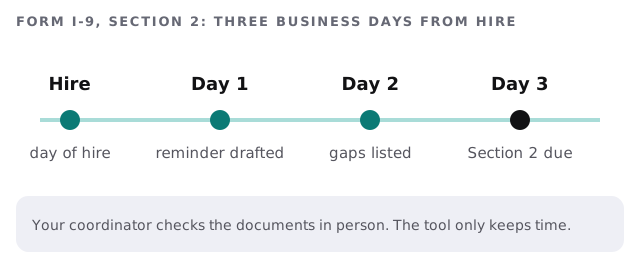
A tool can watch your onboarding checklist and tell a coordinator who is missing what, ranked by start date. It does not review identity documents. We do not claim that any tool makes an agency compliant; compliance depends on your process, and your counsel or the official guidance is the place to confirm it.
Shortlists that show their evidence
When a job order lands, recruiters often re-read the same resumes with the new requirements in their head. A tool can do the first pass differently: list each requirement from the order, and show whether each candidate’s file states it.
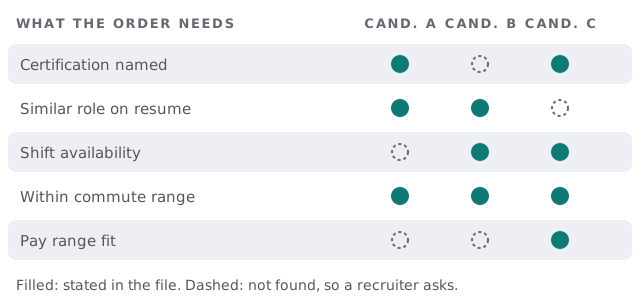
Because the grid shows what was found and where, a recruiter can check it in seconds. The grid never uses names, photos, age or other traits a recruiter should not weigh, and we would build it to leave them out.
Who gets what
| Role | Weekly pain | What a tool prepares |
|---|---|---|
| Recruiter | First reads, outreach, redeployment | Requirement grids, drafted outreach in the recruiter’s voice |
| Account manager | Client updates, fill-rate questions | A short summary per client |
| Payroll and billing | Timesheet exceptions | A ranked exception list |
| Onboarding coordinator | Missing documents | A daily chase list with drafted reminders |
The bench
Between assignments, your best workers are sitting in a database. A tool can list people who finished an assignment well, match them to open orders and draft a short message from their recruiter. It beats a cold search, and it keeps good people from drifting off.
Lines we hold
- A person decides who is submitted and who is not.
- Candidate data stays out of tools your team has not approved.
- Outreach goes out under a recruiter’s name, never as a fake person.
- The tool does not interpret employment law.
The software around an agency
An agency usually runs an applicant tracking system, timekeeping, payroll or a payroll partner, a background-check vendor, email and text outreach and several client portals. They tend to be connected by people. We map them first and then decide where a small internal tool earns its place.
Busy periods
Seasonal ramps in warehousing and events, back-to-school hiring and year-end tax paperwork all put pressure on the same few people. Set up the Monday cycle and the onboarding chase in a calmer month.
What we need from you
A week of anonymized timesheet exceptions, your onboarding checklist, a sample job order and the names of your systems. After the free IT check you get a plan and a fixed quote. A real person replies within 1 business hour, Monday to Friday, 9am to 5pm Pacific.
In staffing, the tool that matters is the one that gets a worker paid correctly and on time. Everything else is a bonus.