AI automation for private equity firms works best on the repeatable layer underneath the judgment. Choosing a deal, pricing it and working with management are partner work. Reading a hundred-page CIM at 11pm to see whether it fits the thesis, or copying numbers from fourteen different monthly packs, is not.
We build small AI tools and internal tools for deal teams and portfolio operations. Your team approves anything shared outside the firm, and every output points back to its source.
From inbound to a yes or a pass
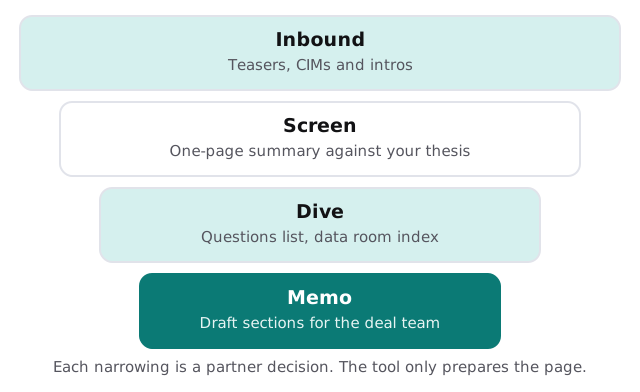
At the top, a tool reads each teaser or CIM and returns a short, structured screen. It lists the business, geography, size, ownership and what the document says about growth, with page references. Anything that doesn’t match your criteria is noted, not hidden. A pass is a person’s call, so nothing disappears without a person seeing a line about why.
Further down, the same tool helps build diligence request lists from a template and your own prior deals, and keeps a tracker of what’s been asked, answered and still open.
Portfolio reporting that arrives on time
Every portfolio company sends a monthly pack, and no two look alike. One uses a spreadsheet, another a PDF and a third a slide deck with numbers in a chart. Someone at the fund copies them into a standard view.
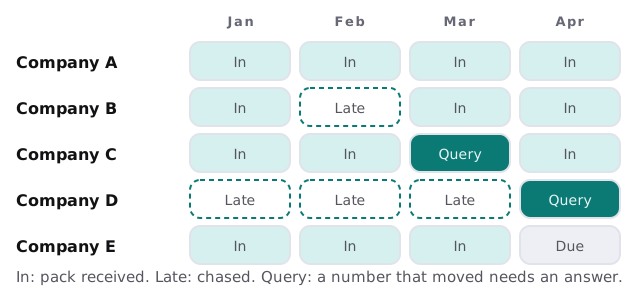
- Remind. A drafted note goes to each company’s finance contact on the date you set.
- Extract. The tool pulls the standard figures from whatever format arrives.
- Compare. It lines them up against budget and the prior month.
- Query. Anything that moved sharply is listed with a suggested question.
- Review. The finance associate checks the figures before the numbers go anywhere.
The quarter-end crunch
| When | What piles up | What a tool prepares |
|---|---|---|
| Quarter close | Valuation inputs from every company | A checklist of what’s in and what’s missing |
| Two weeks after | LP letter drafts | Portfolio commentary from the packs and notes |
| Board season | Decks for each company | Last quarter’s variance table, updated |
| Ad hoc | An LP asks about one holding | A fact sheet drawn from your files |
Venture and growth funds
For a venture fund, the picture looks different. Inbound pitches arrive by the dozen, founder updates are free-form emails, and cap-table questions come from everywhere. A tool can file inbound decks by stage and sector, summarize founder updates into one line per company and keep a running record of follow-ups owed to founders. It doesn’t judge founders and it doesn’t decide who gets a meeting.
The software around the firm
Firms typically run a deal CRM, a virtual data room, spreadsheets for models, a portfolio-monitoring or fund-administration platform and an email-and-calendar suite. Many of these restrict what third-party tools may read, which is why our first meeting covers access, not features.
Questions to ask any provider
- Where is each document processed, and who can see the outputs?
- Does every summary cite pages in the source?
- What happens to documents after the task is done?
- Can we keep restricted deals out of scope entirely?
What we need from you
One or two example screens or packs with figures removed, your investment criteria and the tools you run. After the free IT check we return a plan and a fixed quote. A real person replies within 1 business hour, Monday to Friday, 9am to 5pm Pacific. Trying an assistant on non-confidential material first? Choose an AI assistant for your team compares your options.
The edge in this business is judgment. Let tools protect the time you have for it, and make them show their sources.