AI automation for sales teams sounds like robots writing emails, and that’s usually the wrong place to start. The best return is in the quiet administrative work after the conversation, when notes go unwritten and the CRM stays out of date.
A rep who spends the day selling and the last stretch updating the system is doing the second job badly because they’re tired. Make the second job smaller.
The five minutes after every call
Most CRM data is wrong because entering it is a chore performed at the end of a long day. A call recording or a few typed notes can do that work.
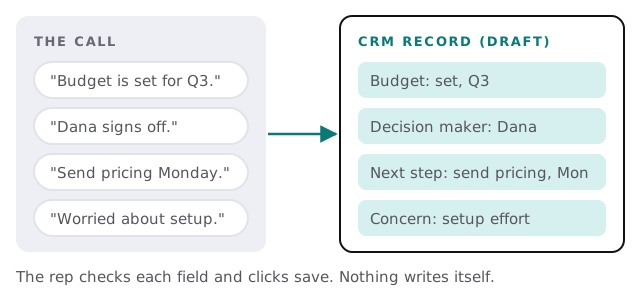
The draft is deliberately conservative. If the buyer didn’t give a date, the field stays empty. A tool that guesses a close date is worse than one that leaves it blank.
Follow-up that sounds like you
After the call, a draft email appears that recaps what was agreed, includes the thing you promised to send, and proposes a next step. It’s written from the call itself, so it mentions the buyer’s actual concern about setup, not a generic line. You trim it, add one personal sentence and send.
Rather build the pieces yourself? Our guides on setting up HubSpot for your team and drafting email replies with Zapier and AI cover them step by step.
The pipeline review nobody enjoys
A manager asked to review forty deals reads forty records, most of them out of date. A tool can do the first pass: which deals have gone quiet, which have no next step, which have a close date in the past.
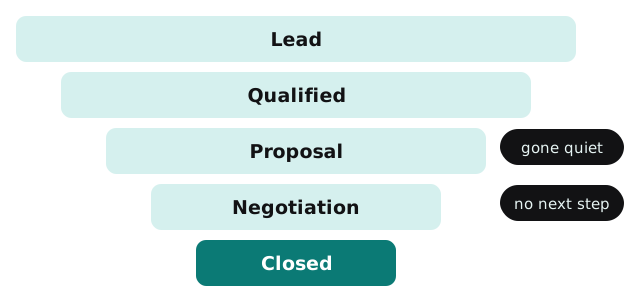
Managers feel the effect too. When notes land in the CRM the same day, a coaching conversation can start from what the buyer actually said, and a rep who is out sick doesn’t take the account history with them.
What to hand to a tool, and what not to
- Hand over: meeting recaps, CRM updates, call summaries, research on a prospect’s company from public pages, first drafts of follow-ups, a list of overdue tasks.
- Keep: the discovery questions you ask, the price you quote, the discount you give, and the decision to walk away.
Sales has its own calendar
Quarter-end makes every flaw in the CRM visible at once. That’s the worst time to build and the best time to find out which flaw costs the most. Note it, build in the weeks after, and let the next quarter run on cleaner data. For outbound teams, setting up Apollo for your team covers prospecting; the tools here are for what happens after someone replies.
Signs you have an admin problem, not a sales problem
- Reps say they’re busy but the pipeline looks thin.
- Forecasts change a lot in the last week of the quarter.
- Notes sit in notebooks, not in the CRM.
- New reps take a long time to find out what happened with an account before they arrived.
Rules we’d set
| Rule | Why |
|---|---|
| Tools draft, reps send | Prospects should hear from a person |
| Empty fields stay empty | A wrong date is worse than none |
| Every field links to the call it came from | The rep can check in seconds |
| Recordings follow your consent practice | You decide, we configure |
On the free IT check we look at your CRM, your call tools and the way reps work today, then you get a plan and a fixed quote. A real person replies within 1 business hour, Monday to Friday, 9am to 5pm Pacific.
Sell during the day. Let the software do the paperwork about it.