AI automation for travel agencies starts with the odd shape of the work. An advisor sells a trip once, then spends weeks assembling it from parts that arrive in different formats from different suppliers. By the day the client leaves, the details sit in a dozen emails, a booking system and the advisor’s memory. We build small AI tools and internal tools that collect those parts into one place, keep the dates in view and draft the messages, with the advisor reviewing everything.
Many confirmations, one itinerary
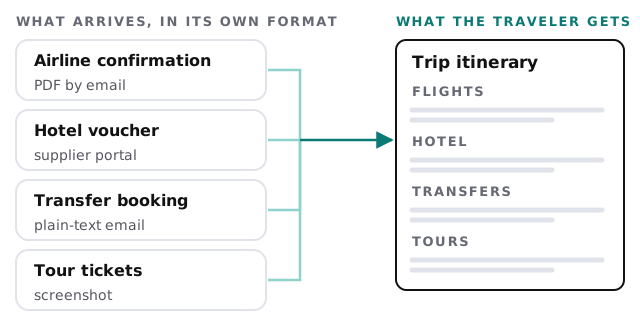
A tool can read each confirmation, pull out the dates, times, confirmation numbers and addresses and lay them into your itinerary template. It highlights anything that does not line up, such as an arrival that lands after the transfer pickup or a hotel night missing between two flights. The advisor fixes and approves it before the traveler sees anything.
The dates that cost money
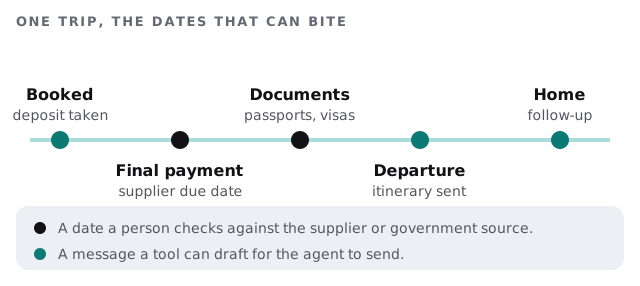
Every trip has deposit and final-payment dates that vary by supplier. A tool can build a single list across all your open trips, sorted by date, with the traveler and the amount owed. It drafts the reminder to the client for the advisor to send. For documents, it adds a task to check the official government source for each traveler’s entry requirements. A person does the check and ticks it off.
What a client asks during a trip
- “What time is my transfer?” The answer is in the itinerary.
- “Where is my voucher?” It is attached to the trip.
- “Can you change this?” This one goes to the advisor, always.
- “Something went wrong.” The advisor calls. A tool only helps by pulling the booking details onto one screen.
Questions one and two can be drafted from the file in seconds. Questions three and four never leave a person.
Commissions, reconciled properly
Suppliers pay commission on their own schedules, and agencies often discover a missing payment long after the trip. A tool can list your completed trips, match them to commission statements and highlight the ones that have not been paid. The owner then chases them. It is slow, dull work that has a direct effect on revenue.
Groups
A group trip or a wedding party multiplies everything: rooming lists, dietary notes, flight changes and many travelers asking the same question. A tool can keep the master list, answer the common questions from it and flag the individual changes that need an advisor.
Who does what
| Person | Heavy admin | What a tool prepares |
|---|---|---|
| Advisor | Itineraries, supplier chasing, client questions | Itinerary drafts, reminders, answers from the file |
| Owner | Commission tracking, reports | Unpaid-commission list, summary of open trips |
| Operations or admin | Payment dates, documents | A date-sorted list with tasks |
| Marketing | Follow-up after trips | A thank-you and a review request |
When the year gets busy
Many agencies see a rush early in the year, when travelers book for the summer, and a second push before the holidays. Departures cluster around school breaks, which means many itineraries must go out in the same week. Build the itinerary and date tools in the slow stretch.
The software around an agency
Most agencies use a booking or reservations platform, supplier portals, a CRM, an itinerary tool, accounting and a card processor. Some of these let you export; others are mostly screens. We start by listing which ones another tool can read.
What we need from you
Three sample trips with their confirmations, the itinerary format you use and the names of your systems. After the free IT check you get a plan and a fixed quote. A real person replies within 1 business hour, Monday to Friday, 9am to 5pm Pacific. To start on the message side yourself, drafting email replies with Zapier and AI is a gentle first project.
The client is buying peace of mind. A good itinerary is how you deliver it, and a good tool keeps it correct.