Key takeaways
- Law firm intake response time is the gap between a person reaching out and your first real reply. You can measure it at your firm in one afternoon.
- Two costs sit behind it: the staff time intake takes, and the matters that went elsewhere while the inquiry waited.
- The lost-matter line is a guess, so make it a range you would defend to your own partners.
- A faster reply should still come from a person. Look for a tool that drafts and waits for approval, not one that answers for the firm.
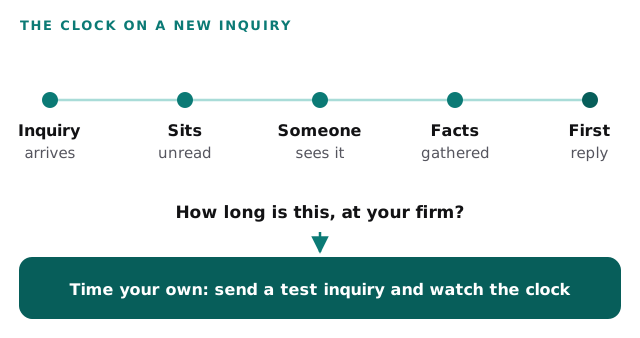
Law firm intake response time is a number you can measure this week, without buying anything. A person fills in your web form on a Friday evening, or leaves a voicemail at lunch, or sends an email to the general address. Somebody at your firm will answer. The question this post asks is when.
You will time it, price the staff hours intake takes and make a careful estimate of what a slow reply costs in matters. Then you will see what to ask for before buying anything to speed it up.
What counts as an inquiry
An inquiry is any contact from someone who might become a client and has not yet. That includes web forms, phone calls, emails to a general address, messages through a directory listing and a text to a partner’s mobile number. Each one is a separate door, and each door may be watched by a different person.
That is where delay begins. If the form goes to one inbox, calls to a front desk and directory messages to a partner’s email, nobody can see the whole list. An inquiry can wait simply because the one person who looks at that door is in court.
Time your own firm
You do not need a survey to know how fast your firm replies. You can test it yourself this week.
- Ask two people outside the firm to contact you as if they needed a lawyer: one through the web form, one through the general email address.
- Have them call your main line at different times of day, including the late afternoon.
- Write down the time of each contact and the time of the first real answer.
- Note who answered, and whether the reply asked for facts or only said “we received your message.”
- Count the contacts that got no answer at all.
If you tell the staff the test is running, you measure how people behave when they know they are watched. So keep the test quiet, and share the results afterward as a fact about the process, not a verdict on a person. Then you have a real number for each door, and a starting point for the conversation with your partners.
What it costs in staff time
Intake takes time even when it goes well. Someone reads the message, calls back, asks questions and writes down the facts. The example column below is made up, to show the format. Use your own counts in the last column.
For the hourly cost, the U.S. Bureau of Labor Statistics says legal secretaries and administrative assistants had a median annual wage of $55,570 in May 2025 (BLS). Divided by the 2,080 hours in a full-time year, that is about $27 an hour before benefits. The same page lists answering telephones, taking messages and scheduling appointments among the duties for the occupation. If a partner takes intake calls, price that time at the partner’s rate instead.
| Line | Example | Yours |
|---|---|---|
| New inquiries a month | 40 | |
| Staff minutes per inquiry, all touches | 30 | |
| Hours a month (40 × 30 ÷ 60) | 20 | |
| Hours a year (20 × 12) | 240 | |
| Cost of a staff hour | $27 | |
| Intake time a year (240 × $27) | $6,480 | |
| Inquiries last month with no answer in a day | 8 | |
| Share you think would have hired you | 1 in 8 | |
| Matters lost a month (8 × 1/8) | 1 | |
| Fee from a typical new matter | $2,500 | |
| Matters lost a year (1 × 12 × $2,500) | $30,000 |
The two halves of this sheet behave differently. Staff time is a known cost that you can read off payroll. The lost-matter lines are an estimate. Treat them as one. Put in a share you would defend, then try halving it and see whether the answer still matters.
The cost nobody sees: the inquiry that went elsewhere
A slow reply leaves no trace. The person does not write to complain. They simply do not write again.
A Harvard Business Review study of how companies answer online queries from potential customers reached a blunt conclusion: its authors said most companies are not responding nearly fast enough (HBR). The study covered companies in general, not law firms, so treat it as a prompt to check your own firm and not as a measure of it.
The mechanism is easy to picture from the other side. If you needed a lawyer and sent the same message to three firms, the one that wrote back first would have your attention. You cannot see whether this happened at your firm, which is why the test above matters. The lawyer’s own time is worth counting too. The Bureau of Labor Statistics says some lawyers work more than 40 hours a week (BLS), and an inquiry that waits for a partner is competing with everything else on that partner’s day.
Why the usual fixes fall short
A firm that finds its number is bad is offered a few standard answers. Each one has a fair case, and each leaves a gap.
An answering service. A live service answers the phone, which is a real improvement for calls. But it does nothing for the web form or the email inbox, and the message it takes still waits for a person at your firm.
A website chat widget. Chat catches visitors at the moment they are on the site. It adds one more door to watch, and the conversation still has to reach someone who can act on it.
Intake forms and software. A good form collects the facts in a consistent order. The form still has to be read, and a person still has to write back. Better data does not shorten the wait on its own.
An auto-reply. “We received your message” is better than silence. It is not an answer, and a person who has asked a specific question may read it as a brush-off.
A new hire. A dedicated intake person gives the inquiry an owner, and that may be exactly right for your firm. It also adds a salary, and the person still works one door at a time and is away on days off and at lunch.
The common thread is that each fix improves one door. The wait for a first real reply is the same across all of them, and that is the number you are trying to move.
What to look for instead
| Ask for | Instead of |
|---|---|
| One list that shows every new inquiry from every door | Several inboxes checked by different people |
| A drafted first reply that a person approves | A bot that replies for the firm with no one checking |
| A reply that restates what the person asked | A generic acknowledgement |
| A named owner for the first reply each day | An assumption that someone will pick it up |
| A trial on your real inquiries before you rely on it | A rollout that begins on day one with every inquiry |
You can read how this kind of setup works on our page about client intake automation for law firms, and about the field on our law firms page. We do not give legal or ethics advice, so any question about what your firm may say in a first reply belongs with your own counsel or bar association.
When you try a new setup, run the same test again. If the time to a first reply drops and your partners still feel in control, it is working.
An assistant to see up close
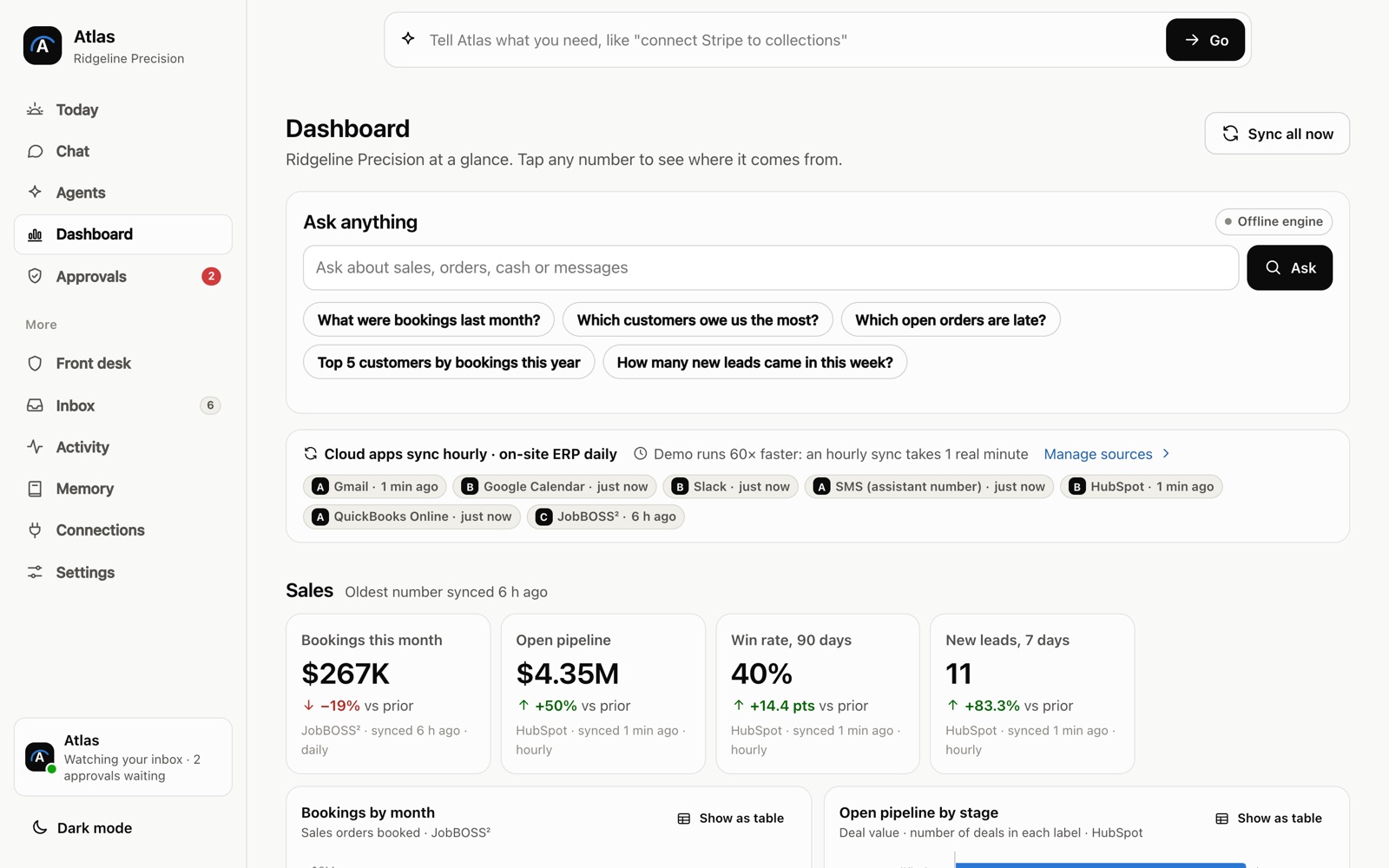
We built an AI executive assistant and operations dashboard. It drafts inbox replies for one-tap approval and answers questions about sales, orders and cash. It is a working demo, shown here on sample data.
It isn’t a law firm intake system. It is worth seeing for one reason. The drafts wait on an approvals screen until a person taps Approve or opens one to edit. That is the question to put to any tool that proposes to speed up your first reply: who decides what goes out under the firm’s name? A real screen answers it better than a feature list.
Behind the scenes
Want a behind-the-scenes walkthrough of a real build?
We will take you through it screen by screen: what each person sees, how a record moves through it, and why we built it that way. Then we can talk about the task that costs you most.
Frequently asked questions
How do I find out how fast my firm really replies?
Send yourself a test. Have a friend or family member fill in your web form, call your main number and email the general address at different times, including the end of a busy day. Write down when each one was answered and by whom.
Whose job should the first reply be?
That is a staffing decision for your partners. What matters for this post is that somebody owns it, and that the owner can see new inquiries without digging through several inboxes.
Does a faster first reply mean a lawyer has to answer every inquiry?
No. The first reply can be a short, accurate message that says the inquiry arrived and what happens next. A lawyer can then take over when the facts are in.
Sources
About the author
Andy Kang, AI Partner Team. Andy Kang writes the blog for AI Partner Team, which builds AI tools and internal apps for small businesses alongside managed IT and IT projects. The blog shows the math and the reasoning behind that work, so you can check it against your own business.
- Every fact links to the page it came from, listed under Sources.
- Example numbers are labelled as examples, and you can swap in your own.
- Builds are shown on sample data, with no client names or client figures.