AI automation for manufacturers rarely means robots. It means the human information that surrounds the machines: the customer’s request for a quote, the supervisor’s note about why line two stopped, the quality inspector’s description of a bad batch. That information exists, but usually in a form no one can use.
We build small AI tools and internal tools that turn it into records and drafts. Your planners and quality leads approve what matters.
The RFQ, step by step
- Read. The request arrives by email with drawings, a bill of materials or a spreadsheet. The tool extracts quantities, materials, finishes and the required date.
- Cost. It matches those against your own costing sheet or past jobs, and drafts quote lines.
- Flag. Anything unusual, such as a tight tolerance or an exotic material, is marked for the estimator.
- Send. The estimator adjusts, approves and sends under their own name.
The goal is a faster first reply, not a different price. Customers shop several suppliers, and the one that answers sensibly first has the advantage.
When a machine goes down
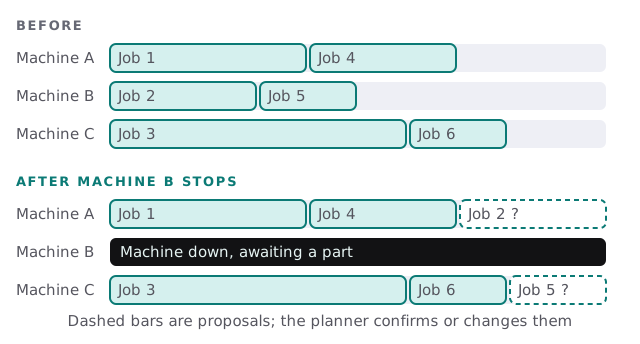
A stoppage is a scheduling problem at once. A tool reads the stoppage note, lists every job on that machine and suggests alternatives based on routing and capacity from your system. It drafts the notes to the customers whose dates would move, and the planner decides what to send.
Quality records that get written
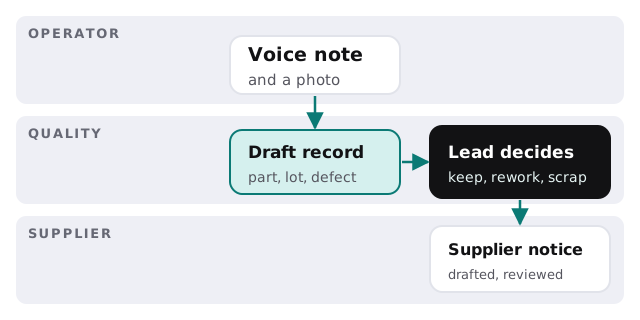
Operators spot defects first, but nonconformance reports often get written at the end of a shift, from memory. A short voice or text note and a photo become a structured draft: part, lot, defect type, quantity and where it was found. The quality lead confirms it and decides disposition. If a supplier is involved, a notice is drafted for review.
Who gets what
| Role | Today | With drafts beside the work |
|---|---|---|
| Estimator | Retypes RFQs into a costing sheet | Reviews extracted lines |
| Planner | Rebuilds the week after each disruption | Chooses between proposed reschedules |
| Quality lead | Reconstructs events from scraps | Confirms a structured record |
| Supervisor | Repeats the handoff verbally | Reads and edits a written one |
The software around the plant
- ERP. Orders, inventory, costing and purchasing.
- MES or shop-floor tracking. Work orders and status, where used.
- Quality systems. Inspections, records and corrective actions.
- Maintenance management. Machine history and scheduled work.
- Email and shared drives. Where the unstructured requests actually land.
We name categories, not products, and never claim an integration until we’ve confirmed what your system allows. For a first self-built connection, setting up Zapier for your team is a reasonable place to start.
A Monday handoff
The weekend supervisor leaves a short voice note. By 6am the Monday lead reads a written summary: two jobs behind, one machine needing a part, a note about a supplier delivery arriving mid-morning. A line that used to start with fifteen minutes of questions starts with a plan.
Questions to ask any provider
- What does it do when a drawing or spec is unreadable?
- Does it write to the ERP, or to a draft area a person reviews?
- Can each extracted number be traced back to the source document?
- Who can see supplier and customer names, and how is that limited?
What we need from you
A few past RFQs with their quotes, your costing sheet, a nonconformance form and the systems your planners use. We return a plan and a fixed quote after the free IT check. A real person replies within 1 business hour, Monday to Friday, 9am to 5pm Pacific.
A machine makes parts. People make decisions. Give the people better information sooner and the plant gets quicker without getting reckless.